
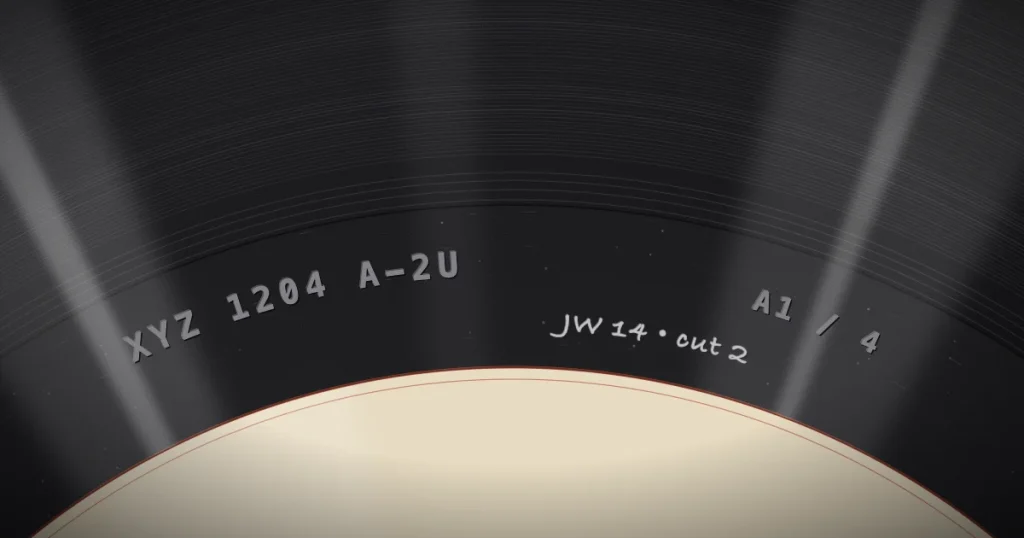
U2 records were pressed in huge numbers, in many countries, over decades, so two copies of the same album can look identical and still be different pressings. The deadwax is where you can tell them apart: the text stamped or etched in the smooth band beside the label identifies the stamper that made each side.
This guide shows you where to look, what the codes mean in general, and what collectors have documented for six of the band’s best-known albums. If you’re new to the term, start with our explainer on what dead wax is.
What is the deadwax on a record?
The deadwax is the smooth, ungrooved band between the end of the music and the label. Look at it under a bright light and tilt the record. You’ll usually see a string of letters and numbers, either pressed into the vinyl or scratched in by hand. Plain English: it’s the factory’s way of labeling which metal stamper made that side.
How to read a U2 matrix number
A matrix number is the code for a particular side of a particular pressing. For many Island releases, you’ll see something like the catalog number, a side letter, and a short suffix for the stamper. Here is how collectors read the parts:
- Catalog prefix: identifies the album and release (for the UK Boy, ILPS 9646).
- Side letter and numbers: tell you which side you are looking at, and which cut and stamper the plant used.
- Stamped marks: pressed into the metal at the plant, so they are the same on every record from that stamper.
- Etched marks: written by hand in the lacquer or the metal, often initials, a mastering house, or a short word. Because they are made by hand, they are the most individual part of the runout.
Two caveats. First, the same album usually has several valid matrix variants. Second, matrix codes tell you which pressing you have, not how it sounds. A “first” matrix isn’t automatically a better-sounding record.
What you need to check a copy
Good light is most of it. A small loupe helps with etched text, and a clean record makes the runout easier to read.
A 10x jeweler’s loupe and a carbon fiber record brush cover it.
U2 deadwax guide, album by album
Each entry below pulls from Discogs release pages, where collectors log the runout text from their own copies. Treat it as a starting point and compare against your record.
Boy (1980)
The UK Island pressing of Boy (catalog number ILPS 9646) is a good place to start, because its runouts are well documented on Discogs. Collectors there have logged six matrix variants, each with a side A and a side B. The release notes say the runouts are stamped, except for the marks reading “SOUND CLINIC” and “JONZ”, which are etched by hand.
That’s the useful lesson for the whole band: two copies of the same album can carry different matrix codes without either being fake. Different stampers and different cuts produce different codes, and you can use them to sort one pressing from another.
- Look for: the ILPS 9646 prefix, then the side letter and the stamper suffix (for example “A-2U” or “B-1U” as logged on Discogs).
- Etched vs stamped: “SOUND CLINIC” and “JONZ” are hand-etched; the rest of the code is stamped into the metal.
- Which is first? Discogs collectors haven’t settled which of the six UK variants came first, so treat the matrix as a way to tell pressings apart, not to date them. The notes do tag the CBS Ireland pressing (
CBS. 84658.A.on side A,CBS. 84658.B. SOUND CLINICon side B) as the “1st Irish pressing” and the Europadisk-pressed US copy (ILPS 1 9646 RE1 E1 #2 edp sound clinicon side A) as the “First US issue”.
October (1981)
- Catalog numbers: UK Island
ILPS 9680, Irish CBSCBS 85369, US IslandILPS 9680. The 2008 remastered 180g reissue is1761679in Europe andB0010829-01in the US. - Pressing plants and matrix patterns: Per Discogs, the UK pressing (release 204231) has six stamped runout variants, such as
ILPS 9680 A-1U TOWN HOUSE 20 2andILPS 9680 B-5U-1-3-12, and several carryTOWN HOUSE, the London studio where the US release notes say it was mastered. The first US pressing (release 8924179) is stamped with an Allied “ɑ” logo and an SLM mark, as inILPS-1·9680-S1 ɑ B-16152-S1 + SLM+++ ∆929. - Stamped vs etched: Discogs lists the UK runout text as stamped and the Irish CBS copy as etched (
CBS-85369-A CP XIIandCBS-85369-B CP XII). On the second US pressing (release 1134199) the notes say the runouts are etched except the stamped SLM and Allied marks. - Original vs reissue: Per the notes, the first US pressing has no credits on the back cover, like the UK sleeve, and the second US pressing adds them. The 2008 Europe 180g reissue (release 2342105) lists
1761679-B 88123E2/A 80787 1B 17616790-B-1 BGon side B, while Discogs has no runout text logged for the 2008 US reissue (release 1815454).
War (1983)
- Catalog numbers: UK Island
ILPS 9733(release 786161, a gatefold), Irish CBSCBS 25347, US Island90067-1(7 90067-1on the spine). The 2008 remaster is1761674in the UK andB0010832-01in the US, and a 2017 reissue repeats1761674. - Pressing plants and matrix patterns: Discogs logs twenty stamped variants for the UK pressing, such as
ILPS 9733 A-1U-1-11-C TOWN HOUSEandILPS 9733 B-1U-1-1-1 TOWN HOUSE, so there is a lot of valid variation. The US copy (release 496426) is noted as the first pressing, with dark purple labels, and the “AR” suffix marks an Allied pressing, with runouts likeSTIL 835155E 1-2 SP-AR B-17800-E △3812 0-1 SRC. - Stamped vs etched: The UK runouts are listed as stamped, with
TOWN HOUSEetched on a single side A variant (variant 15). The Irish CBS copy and the US copy have etched text, and the US copy also has a stamped SRC logo. - Original vs reissue: The 2008 UK reissue (release 1698164) lists etched
1761674 A-2and1761674 B-1with stamped81058 2Aand81058 1B. For the 2017 Europe reissue (release 9979647) the notes say the lacquer was cut by Chris Bellman, assisted by Scott Sedillo, at Bernie Grundman Mastering, and side A reads1761674-A3 cB/SS BG64310-01 A1.
The Unforgettable Fire (1984)
- Catalog numbers: UK Island
U25(also listed asU2 5; release 204237), Irish CBSCBS 26209, US Island90231-1(7 90231-1on the spine). The 2009 remastered 180g reissue is1792416. - Pressing plants and matrix patterns: Per Discogs, the UK pressing has seven runout variants in the pattern of
U 25 A-4-U-1-C-andU 25 B-8-U-1-2 1 GRAEME. The US copy (release 507725) is a Specialty Records Corporation pressing, marked by an SRC logo in the runouts (as inSTIL 845555-C 1-1 [SRC logo] STERLING) and “E A S T” embossed around the spindle hole. - Stamped vs etched: The UK runouts are stamped, and every side B variant also has
GRAEMEetched (Discogs credits Graeme Durham for the lacquer cut). The Irish CBS copy is etched, and Discogs credits the Ⓧ runout etch on US copies to Greg Calbi. - Original vs reissue: The 2009 Europe 180g reissue (release 2098252) lists
83251E1/A www.gzvinyl.com 1792416-A1 BGon side A, and the notes say1792416-A1 BGis etched. The 2019 burgundy 35th anniversary edition (release 13734008) lists1792416-A 188854E1/A 1792416-A5 CB/SS.
The Joshua Tree (1987)
The original UK Joshua Tree arrived in March 1987 on Island (catalog U26) in a gatefold with a poster insert, according to Hi-Fi News. The first US pressing is catalogued 90581-1 and is described there as brown translucent vinyl. The album was reissued on 180g vinyl in 2007 and in a 7LP set in 2017.
- Catalog numbers: UK U26, US 90581-1.
- Pressing plants and matrix patterns: On the UK pressing (release 1341431, an EMI pressing per Discogs) the runouts are stamped across eighteen variants, such as
U 26 A-3U-1-1-8, andTOWN HOUSE DMMis etched on all of them. The US copy (release 1112974) is an Allied pressing, which the notes identify by “SPAR” and a “B-#####” number in the runouts, as inST-1L 876295-A DMM MASTERDISK 3-3 SPAR 0-SMI- △15840 B-26817-A, and the Irish copy (release 7721291), noted as the Irish first pressing on translucent vinyl, uses etched codes likeU2-6-A- POSI 2. - Original vs reissue: The 2007 remastered 180g double LP (US release 2094689) lists
B001031001-LP1-A-3 ⓤon side A, and the Mercury version (release 2804942) lists1750949-A1 69386-1A. The 2017 30th anniversary reissues addCB/SS, matching the lacquer-cut credits for Chris Bellman and Scott Sedillo, as in137285E1/A3 1750949 - A 1750949-A3 CB/SS(Europe, release 10395824) andB0010310-01-A CB/SS(US, release 10488255), and Discogs also lists a 2017 Super Deluxe box with seven LPs (release 10391869).
Achtung Baby (1991)
- Catalog numbers: Discogs files the original 1991 album under Europe rather than UK or Ireland:
510347-1(alsoU28; release 1435215) and a German-made Sonopress pressing,212 110(release 621105). The US edition is314-510 347-1, and the 2018 180g double LP reissue is5797009. - Pressing plants and matrix patterns: Release 1435215, an SNA pressing per Discogs, logs nine runout variants with strings like
U28 A7 (U2 8-A-9)and314-510-347-1-A5-SP2, while the Sonopress copy logs twelve, starting with020 212110 A-1 II (U2 8-A-9). Many of them include an SRC logo, and the US copy, which the notes say was pressed at Specialty Records Corporation, has “E A S T” embossed around the center hole. - Stamped vs etched: Not documented on Discogs for the Europe releases. The US copy lists
(U2 8-A-10) 314-510-347-1-AS-SP3 1-1as etched, with a stamped SRC logo on both sides. - Original vs reissue: The 2018 Europe reissue (release 12298689) is a 180g double LP made in the Czech Republic, and Discogs lists runouts such as
5797011-A 174614E1/A 5797011-A2 CB/SS, stamped except5797011-A2 CB/SS, which is etched.
FAQ
What does the deadwax on a U2 record tell me?
The deadwax (also called the runout) is the blank band between the last groove and the label. It carries the matrix number, which identifies the stamper and cut used to make that side. Collectors use it to tell one pressing of a U2 album from another.
Are the scratched-in messages on U2 records deliberate?
Some runout marks are hand-etched by the people who cut or mastered the record. On the UK Boy pressing, Discogs lists etched marks reading SOUND CLINIC and JONZ among its matrix variants. Treat them as credits or signatures rather than hidden messages unless a source says otherwise.
Does a different matrix number mean a record is fake or a bootleg?
Not by itself. Multiple stampers and cuts were used for popular albums, so legitimate copies of the same release often have different matrix codes. A bootleg is better spotted by the label, sleeve and sound, with the matrix as supporting evidence.
How do I check my U2 record against a database?
Search the catalog number on Discogs, open the release that matches your label and sleeve, and compare the matrix text in the Barcode and Other Identifiers section with what is on your record. Use a bright light and a magnifier, since deadwax text is small.
Keep going
Once you know what you’re holding, keep it in good shape. Our guide to upgrading your vinyl setup covers the gear, and how to pick the right turntable helps if you’re starting from scratch.