
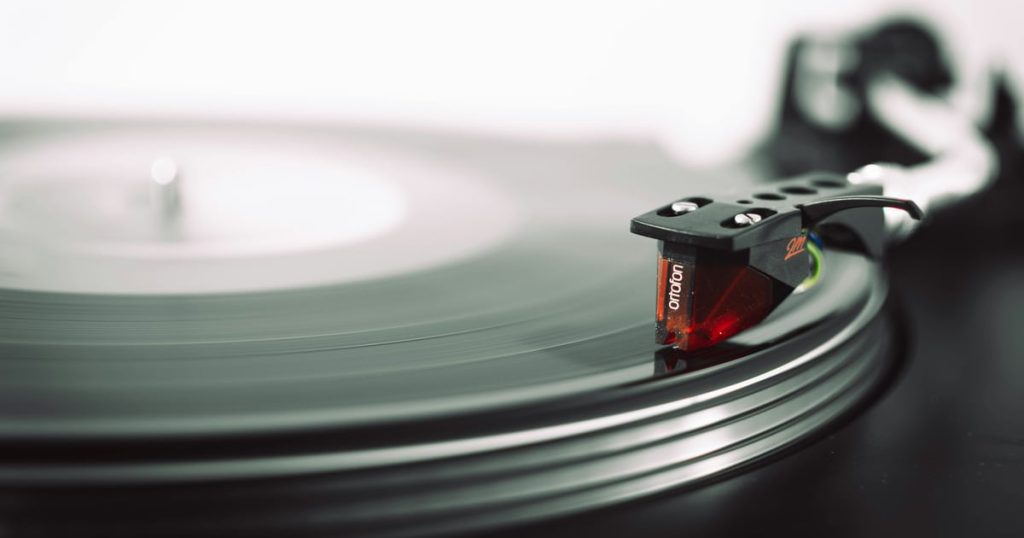
At some point every record collector has the same moment. You drop the needle on an album you love, and it sounds fine. Just fine. And “fine” starts to bug you.
The good news is that upgrading a vinyl setup doesn’t mean replacing everything, and it definitely doesn’t mean spending the kind of money that gets you side-eye at home. Most of the improvement comes from a few smart moves made in the right order. Some of them cost nothing at all.
Here’s how to think about it, starting with the cheapest wins and working up.
Step zero: make sure the turntable is actually worth upgrading
Before anything else, an honest question. If your turntable is a suitcase-style player with built-in speakers, a plastic tonearm with no counterweight, or a cartridge you can’t replace, the turntable itself is the bottleneck. Nothing you plug into it will fix that.
Those players usually track heavy (sometimes double or triple what a decent cartridge needs) and can wear your records faster than they should. If that sounds like your setup, skip ahead to the turntable section, or read our guide to picking the right turntable, or go straight to our Turntable Guide to see what a real step up costs. Your records will thank you.
If you’ve got a turntable with an adjustable counterweight and a cartridge you can swap out, you’re in good shape. Read on.
1. Dial in what you already have (cost: free)
Heads up: the product links in this guide are affiliate links. If you buy through one, Dead Wax Labs may earn a small commission at no extra cost to you.
This is the least exciting advice and the most underrated. A lot of turntables sound mediocre simply because they were set up in five minutes on the day they came out of the box.
- Level it. Put a small bubble level (or a level app on your phone) on the platter. A tilted turntable puts uneven pressure on the stylus.
- Check tracking force. Your cartridge has a recommended tracking force, usually around 2 grams for common moving magnet cartridges. The numbers on the counterweight dial are a rough guide at best. A cheap digital stylus force gauge (often under $20) tells you the real number.
- Set anti-skate. Most people match it to the tracking force and call it a day. That’s a perfectly reasonable starting point.
- Check alignment. If the cartridge is twisted or sitting too far forward in the headshell, it can’t read the groove the way it was designed to. A printable protractor or an inexpensive cartridge alignment protractor and twenty patient minutes can make a surprising difference, especially on inner tracks where distortion tends to creep in.
- Move it away from the speakers. If your turntable sits on the same piece of furniture as your speakers, bass vibrations travel right back into the stylus. This can make things sound muddy or boomy. A separate shelf or stand helps a lot.
None of these are glamorous. All of them are worth doing before you buy anything.
2. Clean your records and your stylus (cost: almost free)
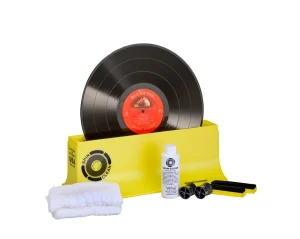
A basin and brush system you rotate the record through by hand. An affordable way to deep-clean used finds.
Dust and grime in the grooves cause a lot of the crackle people blame on “vinyl being vinyl.” A carbon fiber record brush before each play handles surface dust. For used records with years of gunk, a proper wet clean makes a big difference, whether that’s a Spin-Clean style washer or a hand cleaning kit.
Your stylus needs love too. A small stylus brush, used gently from back to front, keeps fuzz from building up on the tip. If you’ve ever seen a little dust bunny riding on your needle mid-song, you know what we mean.
While the record’s out, flip it over and look at the smooth band near the label. That’s the dead wax, and it’s full of clues about who made your record and where. We explain what dead wax is and how to read it.
3. Upgrade the cartridge or stylus (cost: roughly $50 to $200)
This is where most people get the biggest jump in sound for the money. The cartridge is the part that actually reads the music out of the groove. Everything after it can only work with what the cartridge gives it.
Two things to know here:
Styli wear out. A worn stylus doesn’t just sound worse, it can damage your records. Estimates vary a lot depending on the stylus shape and how clean your records are, but somewhere in the range of several hundred to around a thousand hours of play is a common rule of thumb. If you’ve been spinning the same needle for years, or you hear harsh, spitty “S” sounds on vocals that didn’t used to be there, it’s probably time.
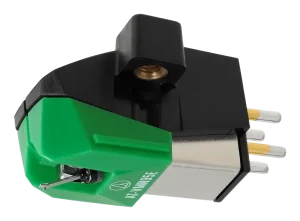
A popular moving magnet cartridge. The body stays put and you can swap in a better stylus later.
Some cartridges let you upgrade just the stylus. Audio-Technica’s VM95 series is a good example. The body stays put and you can swap in a better stylus later without remounting anything. The Audio-Technica AT-VM95E is a popular starting point at around $60 to $70, and a lot of turntables ship with it already.

A moving magnet cartridge with a lot of fans. It leans a little warmer than the Audio-Technica.
The Ortofon 2M Red works similarly within its own family, and it’s usually found somewhere around $100 to $110. Both are good choices with a lot of fans. The Ortofon leans a little warmer, the Audio-Technica a little brighter.
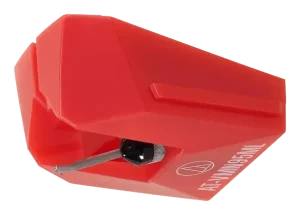
A microline replacement stylus that slots onto a VM95 body for more detail and less distortion near the end of each side.
Moving up a stylus grade, from elliptical to a fancier profile, generally gets you more detail and less distortion near the end of each side. If you already own a VM95 body, the AT-VMN95ML microline stylus or AT-VMN95SH Shibata stylus slide right in. It’s one of the most satisfying upgrades in the hobby because you hear it right away on records you know by heart.
4. Get a dedicated phono preamp (cost: roughly $100 to $250)
Turntables put out a tiny signal that needs a special boost (and an EQ correction) before your amp can use it. That’s what a phono preamp does. Lots of turntables have one built in, and they work, but they’re usually built to a price. Same goes for the phono input on many budget receivers.
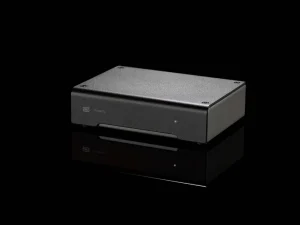
A quiet outboard phono preamp with adjustable settings, so it works with a wide range of cartridges.
An outboard phono preamp tends to be quieter and clearer, with less background hiss between tracks and a bit more punch and space in the music. The Schiit Mani 2 is a common recommendation for good reason. It runs about $149, it’s quiet, and it has adjustable settings, so it works with a wide range of cartridges if you upgrade later.
If your turntable has a built-in preamp, look for a switch on the back (often labeled “Phono/Line”). Set it to Phono to bypass the built-in one when you add an external preamp. Shopping for a new turntable and not sure whether you need one? The Turntable Guide lets you filter models by whether they have a preamp built in.
5. Speakers and where you put them (cost: free to whatever you want)
Speakers make the biggest difference in overall sound of anything in the chain. Two pairs of speakers at the same price can sound wildly different, so this is where your own ears matter most.
But before you buy new ones, try moving the ones you have. A few tips:
- Pull them out from the wall. Even 6 to 12 inches can tighten up bass that sounds bloated.
- Get the tweeters roughly at ear height when you’re sitting.
- Try forming an equilateral triangle between the two speakers and your head.
- Angle them in slightly toward your listening spot and see if the center image snaps into focus.
- Bookshelf speakers on an actual bookshelf, wedged between paperbacks, will never sound their best. Speaker stands make a real difference.
When you do upgrade, go listen if you can. Bring a couple of records you know really well. Trust what you like over what a review says you should like.
6. The amplifier (usually last)
Amps matter, but for most people they’re not where the bottleneck is. If your current amp drives your speakers to a comfortable volume without straining, and doesn’t hum or distort, it’s probably not your weakest link.
The exception is when you upgrade to speakers that are harder to drive. Some speakers want a lot more power than others, so if you’re shopping for speakers, check that your amp is a good match. Powered speakers with a phono input are also a great way to simplify things, since the amp and preamp are already built in.
7. Upgrade the turntable itself
If you’ve done everything above and want to go further, or if your turntable is the bottleneck from the start, here’s what to look for in a better one:
- An adjustable tonearm with a real counterweight. This is the non-negotiable.
- A replaceable cartridge, so you can upgrade it later.
- A heavier, more stable build. Mass and good isolation help keep vibrations out of the music.
- Stable speed. Wobbly pitch on sustained notes (piano is a good test) is a sign of a speed problem.
Belt drive versus direct drive is less important than build quality. Both can sound great. And don’t sleep on the used market. A well-kept vintage turntable from a solid brand can outperform a lot of new budget models, as long as it’s in good working order.
If you’re buying new, our Turntable Guide puts 46 models side by side with specs, published review scores, and Amazon price history, so you can tell whether today’s price is actually a good one. You can sort and filter by drive type, built-in preamp, Bluetooth, and budget, or jump straight to a price range: under $200, $200 to $399, $400 to $599, $600 to $999, or $1,000 and up.
What you can probably skip
Expensive interconnect cables, fancy power cords, and anything sold with phrases about “quantum” or “energy alignment” are not where your money should go. Decent, well-made cables are worth having. Cables that cost more than your cartridge are not going to make your records sound better.
A sensible upgrade order
If you want the short version, here it is:
- Set up what you have properly (free)
- Clean your records and stylus (cheap)
- Replace a worn stylus or upgrade the cartridge
- Add an outboard phono preamp
- Reposition, then upgrade, your speakers
- Upgrade the amp if your speakers need it
- Upgrade the turntable (the Turntable Guide helps here)
And if a full upgrade feels like a lot right now, remember the other path to a better listening experience: more good records. Scout tracks vinyl prices on Amazon and flags when albums drop below their usual price, so your upgrade budget and your record budget can coexist peacefully.
FAQ
What’s the best first upgrade for a vinyl setup?
Proper setup and cleaning come first because they’re free or close to it. After that, a new cartridge or stylus usually gives the biggest improvement for the money.
How do I know if my stylus is worn out?
Common signs include harsh or distorted “S” sounds on vocals, more distortion near the end of each side, and the needle skipping on records that used to play fine. If you can’t remember when you last replaced it, that’s a clue too.
Do I need a separate phono preamp?
Not necessarily. If your turntable or amp has a built-in phono stage, it’ll work. An outboard phono preamp usually sounds quieter and clearer, which makes it a worthwhile upgrade once your cartridge is sorted.
Should I upgrade my speakers or my turntable first?
If your turntable has an adjustable tonearm and a replaceable cartridge, upgrade the cartridge and phono preamp before the turntable. Speakers can be a bigger change overall, so try repositioning yours first and see how much you gain for free.
Are expensive cables worth it?
For most systems, no. Well-made, reasonably priced cables are all you need. Put that money toward a cartridge, a preamp, or more records.