
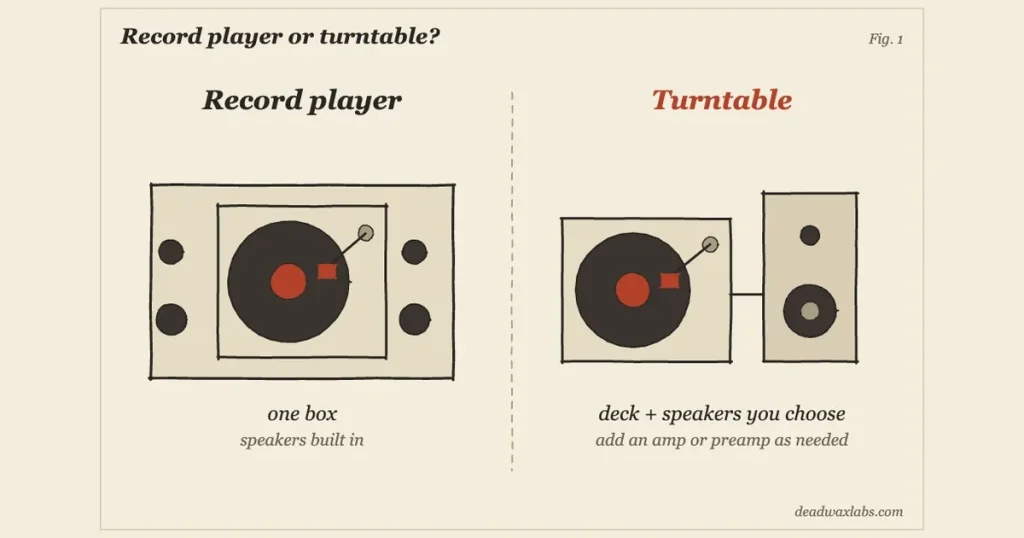
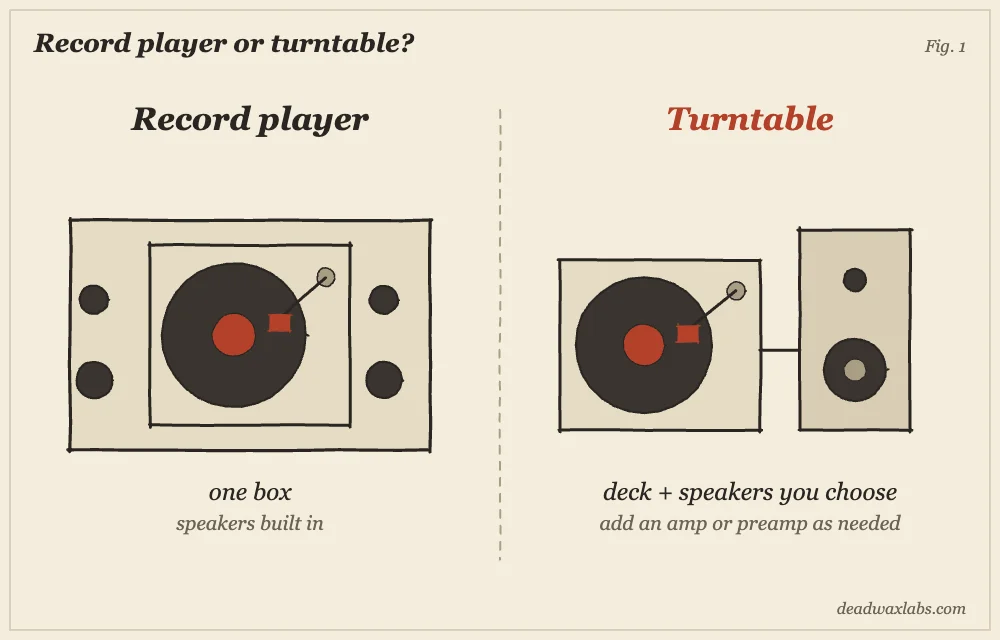
In everyday conversation, a record player and a turntable are the same thing: a machine that plays vinyl. In audio-gear terms there is a useful difference. A record player is an all-in-one unit with a built-in amplifier and speakers. A turntable is just the deck that spins the record and reads the groove, so you add the rest yourself.
That difference matters when you shop, because it decides what you pay, how it sounds, and whether you can improve it later. Here’s how it breaks down.
The short answer
| Record player | Turntable | |
|---|---|---|
| What it is | All-in-one: deck, preamp, amp and speakers | The deck alone |
| What you add | Nothing | Speakers, an amp, and possibly a phono preamp |
| Best for | Casual listening and simplicity | Better sound and upgrades over time |
One caveat before we go further. Most of what’s written on this topic comes from shops and speaker makers with something to sell, including Audioengine, Victrola and KB Audio. They agree on the basics, and we’ve cited them for those, but their sound-quality claims are opinion, not testing. We’ll point out where that matters.
Where the two words come from
People use the terms loosely. Rough Trade uses “record player” and “turntable” interchangeably, and KB Audio acknowledges the terms are often swapped. Their rule of thumb: if the package includes an amp and speakers, it’s a record player; if not, it’s a turntable. That is how we’ll use the words here.
Victrola puts the relationship simply: every record player includes a turntable, but a turntable alone isn’t a record player.
What a record player (all-in-one) includes
A record player combines the turntable, a preamp, a power amplifier and speakers in one box, per Victrola and Audioengine. You plug it in, drop the needle and listen. Many are compact, and some are portable or battery-powered.
The trade-offs are the same everywhere you look. Sound quality is limited by the parts built into the box, the small speakers in particular, and you can’t easily swap out components. Audioengine argues the small built-in speakers tend to sound tinny and struggle with bass, but remember it sells speakers.
What a turntable (component) includes
A turntable is the motor-driven platter, the tonearm and the cartridge. That’s it. To hear anything you need a phono preamp, an amplifier and speakers, which can be separate pieces or built into powered speakers. Our guide to the parts of a turntable walks through every piece.
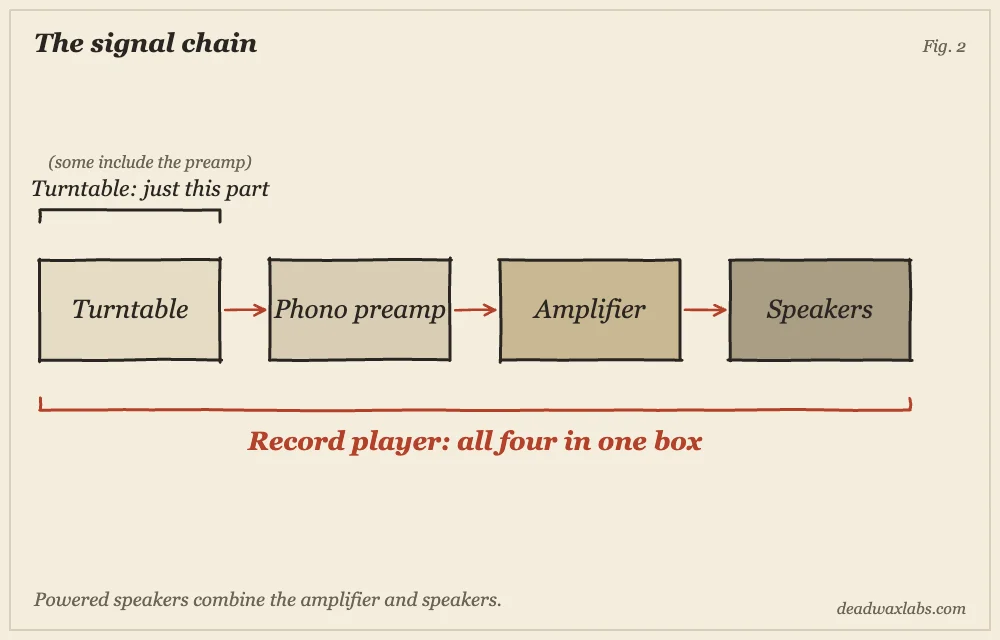
The reason for the chain: the stylus reads the groove, the cartridge turns that into a very weak electrical signal, and that signal needs a preamp and then an amplifier before speakers can use it, as Victrola explains. The benefit of separates is choice. You can pick the speakers you like and upgrade the cartridge, tonearm or speakers one at a time.
Record player vs turntable, side by side
| Record player | Turntable | |
|---|---|---|
| Setup | Plug in and play | Needs matching speakers and cables |
| Upgrading | Limited. Parts are built in | Swap the cartridge, speakers, preamp and more |
| Sound | Capped by built-in parts and small speakers | Depends on what you pair it with |
| Upfront cost | Usually lower | Usually higher once you add speakers |
| Space and portability | Compact, often portable | Modular, takes more room |
This lines up with The Audio Keeper and KB Audio, which also describe record players as cheaper up front and turntables as better long-term investments.
Can a cheap all-in-one damage your records?
You’ll see this claim a lot. It’s true for some models, not every one. What Hi-Fi? measured the Crosley Cruiser’s tracking force at just over 7 grams, against about 2.5 grams on most turntables, and warned that the weight would wear records over time. Their verdict was to keep it away from your collection. Your Sound Matters makes similar points about fixed, non-adjustable arms and heavy tracking on cheap players.
So the lesson isn’t “never buy an all-in-one.” It’s to check the tracking force and whether the arm and cartridge are adjustable before you buy, and to be careful about playing records you care about on the cheapest suitcase models.
The middle ground that suits most people
You don’t have to choose between a one-box player and a full hi-fi stack. Rough Trade recommends beginners keep it simple by choosing a turntable or a set of powered speakers that has a preamp built in, so you can start listening right away. Only one of the two needs a preamp.
- A turntable with a built-in preamp. Rough Trade highlights the Audio-Technica AT-LP60X, which has a switchable built-in preamp.
- Powered speakers. The Edifier R1700BT has a built-in amplifier and Bluetooth. Audioengine makes powered speakers like the A2+.
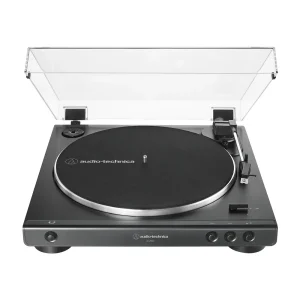
A fully automatic turntable with a switchable built-in preamp, so it works with powered speakers or a regular amp.
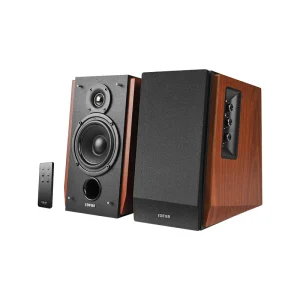
Powered bookshelf speakers with a built-in amplifier and Bluetooth. No separate amp needed.
Pair a turntable like that with powered speakers and you get a simple system in two boxes plus a couple of cables, and you can swap speakers or add an amp later. For a broader walkthrough, see how to pick the right turntable.
Which should you buy?
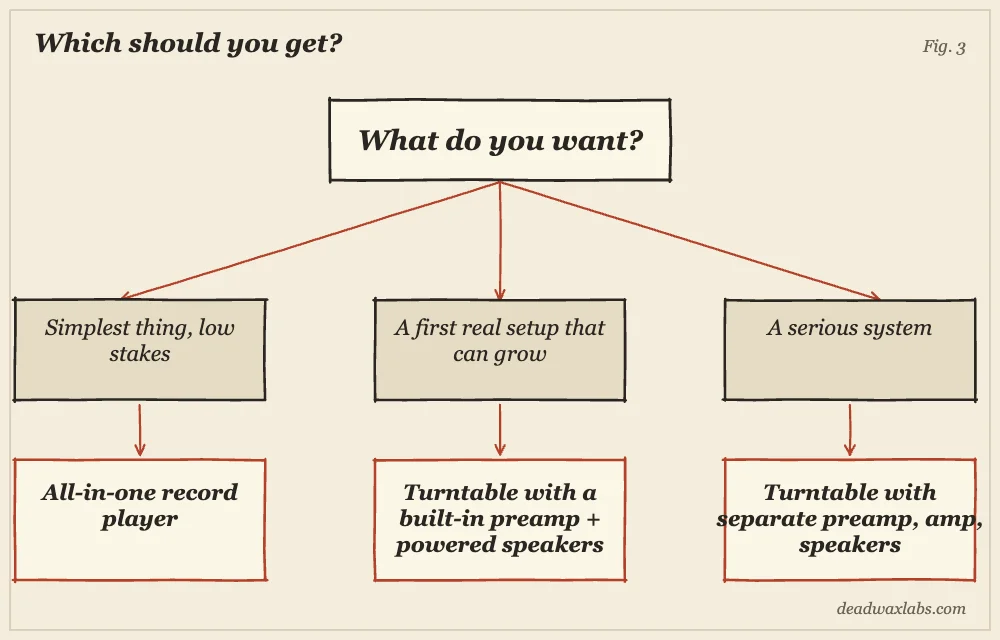
- You want the simplest thing and the stakes are low. An all-in-one record player will play records. Check the tracking force first if you care about your records.
- You want a first real setup that can grow. A turntable with a built-in preamp plus powered speakers.
- You’re building a serious system. A turntable with a separate preamp, amp and speakers. Our guide to upgrading your vinyl setup shows what to change first.
FAQ
Are a record player and a turntable the same thing?
In everyday speech, yes. People use both words for a machine that plays vinyl. In gear terms, a record player usually means an all-in-one unit with built-in speakers, while a turntable is the deck alone and needs an amp and speakers.
Is a phonograph or gramophone the same as a record player?
They’re older names for the same idea: a machine that plays records. “Phonograph” and “gramophone” show up mostly in older equipment and in some regions, and today most shops just say record player or turntable.
Do I need a phono preamp with a turntable?
Yes, somewhere in the chain. A cartridge produces a very weak signal, so it needs a preamp before an amplifier. Some turntables and some powered speakers have one built in, per Rough Trade, but only one of them needs it.
Can a cheap all-in-one record player damage my records?
Some can. What Hi-Fi? measured the Crosley Cruiser’s tracking force at just over 7 grams, against roughly 2.5 grams for most turntables, and warned the weight would wear records over time. Not every all-in-one is that heavy, so check the specs.
Which should a beginner buy, a record player or a turntable?
For most beginners, a turntable with a built-in phono preamp plus a pair of powered speakers is the best middle ground. It’s simple to set up and can be upgraded later. A plain all-in-one is fine as a short-term, low-stakes option if you accept its limits.
In the market for a new turntable?
If you’ve decided you want a turntable rather than an all-in-one, browse our Turntable Guide to compare models side by side.