
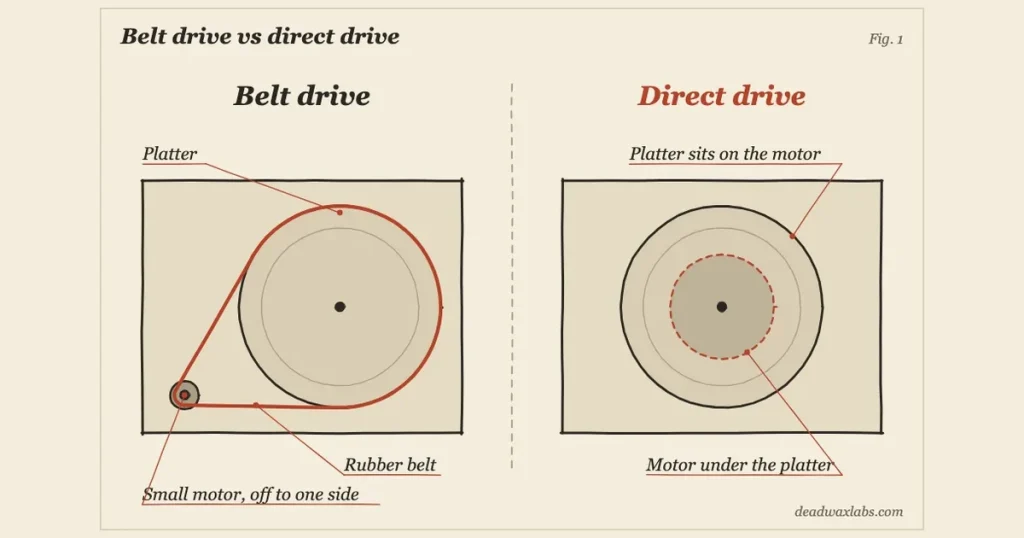
The difference between direct drive and belt drive is how the motor turns the platter. In a belt-drive turntable, a rubber belt connects a motor sitting off to the side to the platter. In a direct-drive turntable, the motor sits right under the platter and turns it directly.
Neither is simply “better.” Direct drive starts fast and suits DJs. Belt drive keeps the motor at a distance and is a favorite for home listening. For most people picking a first turntable, other things matter more, and we’ll explain which.

The short answer
| Belt drive | Direct drive | |
|---|---|---|
| How it works | Side motor, rubber belt to the platter | Motor under the platter |
| Best for | Home listening | DJing and quick starts |
| Main drawback | The belt wears out | Motor closer to the stylus |
How a belt-drive turntable works
A belt-drive turntable runs a rubber belt around the underside of the platter to a separate motor, according to Audio-Technica. Because the belt is the only link, the motor is isolated from the platter, which keeps its vibration away from the stylus. Better models suspend or separate the motor even more, per Audio Advice.
Audio-Technica says belt-drive turntables can sound good even at modest prices. The trade-offs: the belt wears out and needs periodic replacement (new belts are inexpensive and easy to fit), and the platter takes a moment to reach full speed. Victrola adds that the belt can be audible and, over years, can stretch enough to make records play slightly slow.
How a direct-drive turntable works
In a direct-drive turntable, the platter is attached straight to the motor. Audio-Technica notes that there’s no belt, so it offers strong torque, stable speed, and fast starts and stops, often with pitch control. With fewer moving parts and no belt to replace, it’s durable. The catch is that the motor must be carefully designed and damped so its vibration doesn’t reach the stylus, which typically raises the price.
That’s why direct drive dominates DJ decks. Victrola points out that a direct-drive platter reaches the correct speed almost immediately and responds precisely to hand movement, which suits scratching and mixing.
Direct drive vs belt drive, side by side
| Belt drive | Direct drive | |
|---|---|---|
| Motor vibration | Isolated by the belt | Motor sits closer to the platter and needs good damping |
| Startup | Takes a moment to reach speed, from about a second to a few seconds depending on the source | Reaches speed almost instantly |
| Speed options | Usually 33 and 45 RPM | Often adds pitch control |
| Maintenance | The belt wears out | No belt to replace |
| Price | Plenty of affordable models | Typically costs more, though budget models exist |
| Best for | Home listening | DJs, and anyone who wants quick starts |
Pulled from Audio-Technica, Audio Advice and Victrola. They agree on the mechanics. They don’t fully agree on sound, covered next.
Myths and what’s actually true
“Belt drive always sounds better”
Victrola says many enthusiasts find belt-drive sound cleaner and more detailed, and that direct drive generally has lower sound quality, though it admits that’s subjective. Audio Advice takes a more cautious view: it argues direct-drive speed circuitry can introduce tiny fluctuations some listeners notice, but that newer motors and heavy platters have reduced them, and that drive type alone doesn’t decide quality. Both agree the tonearm, cartridge and overall build matter too. So it’s a trend people argue about, not a rule.
“Direct drive is only for DJs”
Not true. What Hi-Fi?’s early look at the Technics SL-1200 MK7 says it’s aimed at DJs and hi-fi fans alike, and found it well balanced and musical. That was a brief first listen, not a full review, but it shows direct drive isn’t confined to the club.
“A belt means constant maintenance”
Belts do wear out, but Audio-Technica notes that new ones are inexpensive and easy to fit. See the next section.
Belt care: when and how to replace it

A belt typically lasts one to five years, according to KB Audio, depending on how often you play and on dust, humidity and temperature. Signs it needs replacing: visible cracks, a stretched belt, inconsistent speed, or a platter that won’t turn. A snapped belt won’t harm the turntable, but playback stops until you fit a new one.
The basic steps, per KB Audio and Victrola: unplug the turntable, remove the platter, note how the old belt wraps, clean the area, loop the new belt along the same path, reassemble and check the speed. Buy the manufacturer’s recommended belt, or an exact match. Our guide to the parts of a turntable shows where the motor, platter and belt sit.
Example models
- Belt drive: the Audio-Technica AT-LP60X is a popular starter belt-drive deck.
- Direct drive, budget: the Audio-Technica AT-LP120XUSB. A Louder review called it an excellent budget direct-drive deck that is extremely stable and sounds good, with a faint whine on USB recordings the main caveat. Note that you’ll need to set the tracking force yourself, since the factory setting doesn’t match the cartridge’s range.
- Direct drive, classic: the Technics SL-1200MK7, the revived DJ and hi-fi favorite.
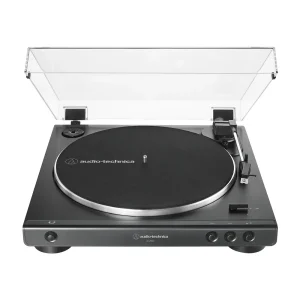
A fully automatic belt-drive turntable with a switchable built-in phono preamp. Plug it in and play.

A budget direct-drive deck with USB output. It is fully manual, so you set the tracking force yourself.

The revived DJ and hi-fi favorite. Direct drive, with the motor right under the platter.
Which should you buy?

- Mostly listening at home: belt drive is a safe choice, and Audio Advice calls a well-built belt-drive turntable the best value for listening, if it has a heavy platter and isolated motor.
- DJing, scratching or beat-matching: direct drive.
- You hate the idea of a part that wears out: direct drive, with no belt to replace.
- Not sure: don’t agonize. Choose on the tonearm, cartridge, build and your budget, which Audio Advice says matter as much as drive type. Our guide to how to pick the right turntable walks through all of it, and the record player vs turntable post covers the all-in-one question.
FAQ
Is direct drive better than belt drive?
Neither is better in every case. Direct drive starts and stops quickly and suits DJing. Belt drive isolates the motor from the platter and is a common choice for home listening. Audio-Technica and Audio Advice both say the right choice depends on how you’ll use the turntable.
What does belt drive mean on a turntable?
A rubber belt connects the motor to the platter. The motor sits off to the side, so less motor vibration reaches the stylus. The belt wears out over time and needs replacing.
Do direct-drive turntables have belts?
No. In a direct-drive turntable the motor sits under the platter and turns it directly, so there is no belt to wear out.
Can you scratch with a belt-drive turntable?
It’s not what the design is built for. Direct-drive platters reach speed almost immediately and respond precisely to hand movement, which is why DJs use them, according to Victrola. A belt-drive platter takes a moment to get up to speed.
Does drive type affect sound quality?
It can, but it isn’t the whole story. Audio Advice says drive type alone doesn’t determine quality, because the tonearm, cartridge and overall build matter too. Sources disagree about which type sounds better, so treat it as partly a matter of taste.
How often do you replace a turntable belt?
A belt typically lasts one to five years, according to KB Audio, depending on use and conditions. Replace it if it’s cracked, stretched or records play at the wrong speed.
In the market for a new turntable?
Browse our Turntable Guide to compare models side by side, then see our guide to upgrading your vinyl setup for what to change first.